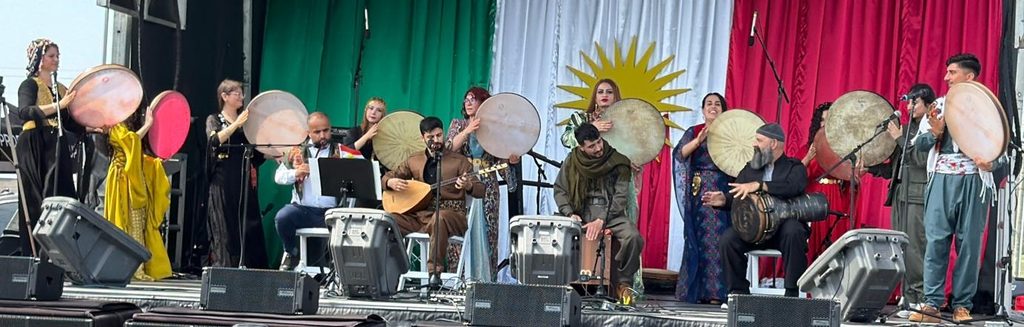
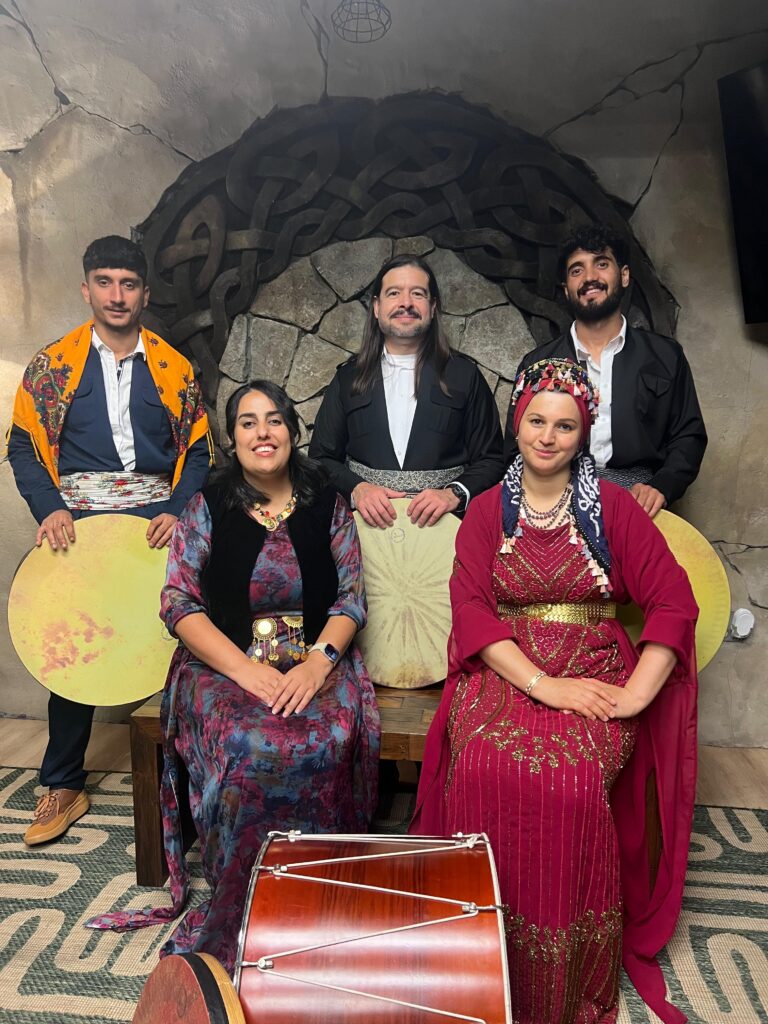
Established in 2023 by teacher and group leader Nesrin Şimşek, the KCMA Rhythm Group has become a leading ambassador for Kurdish music and culture in the Nashville community and beyond. Consisting of both professional musicians and players drawn from KCMA’s classes and educational activities, the ensemble’s lineup includes up to 10 daf players, tembûr (Kurdish lute), vocals, and additional percussion, offering energetic performances that embody the spirit of Kurdish culture and tradition. Their repertoire includes traditional and contemporary songs written and popularized by Aram Tigran, Mihemed Şexo, Xelîl Xemgîn, and many others.
The KCMA Rhythm Group performs regularly throughout the year at public venues and special events.
Click here to view a list of upcoming KCMA Rhythm Group performances.
Contact us if you’d like to host performance by the KCMA Rhythm Group.
The Daf: A Symbol of Kurdish Women’s Strength and Resistance
Music is often described as the soul of a culture, and in Kurdish society, no instrument embodies this better than the daf. This instrument is more than just a frame drum — the daf carries centuries of tradition, spirituality, and collective identity. The daf has functioned as a symbol of both empowerment and cultural continuity, and its significance is derived in part from its relationship with Kurdish women, who have been recognized as powerful performers and cultural guardians.
We can understand the impact of the daf on Kurdish women through examining how its role has changed over the years. Historically, the daf was used mostly in religious and communal ceremonies. It had a central role in Sufi rituals, weddings, and other gatherings where its rhythmic patterns helped guide the spiritual mood. However, in those times, performances were generally limited to men, because women were not allowed to perform in public or religious spaces. In more recent times, the purpose of the daf has expanded beyond rituals. It’s now performed at concerts, festivals, and even on international stages, while still maintaining its spiritual roots. Kurdish women have become more active in shaping how the daf is performed and understood, in the process affirming the daf not simply as a symbol, but also an actualization of women’s empowerment.
Historically, Kurdish women were typically limited to watching during events where the daf was played, and they were not able to take part in the music itself. This reflected the larger gender roles that existed in society. But during the past century, this started to change. Women began to play the daf, at first in local and family gatherings, and over time they entered more public and even professional spaces. Now some of the best-known daf performers are women, using the instrument not just musically, but also as a way to give expression to power and resistance. Through playing, they affirm their identity and also challenge gender norms.
Traditionally, the daf was handmade from wood and animal skin, giving it a natural sound tied to spiritual feelings. Its design was simple but meaningful, embodying a connection between nature and community. In modern times, synthetic materials and mass production have made the daf more accessible and durable. This has allowed more people, including women, to get involved with the instrument. Even if the physical materials have changed, the cultural meaning and spirit of the daf have remained intact.
The daf has always played a unifying role in Kurdish culture, but what it represents has shifted. In the past, it was mostly about religion and community, but women weren’t really part of that picture. Today, however, the daf means much more—it stands for cultural identity, women’s strength, and collective resistance. For Kurdish women, it’s a way to connect with heritage and also to speak up for justice and equality. The rhythms of the daf now carry messages of both tradition and protest, linking a deeply rooted history of Kurdish resistance with modern activism while keeping Kurdish musical heritage alive and demonstrating how much Kurdish women have transformed their role in this story.
— Asiye Taşkın